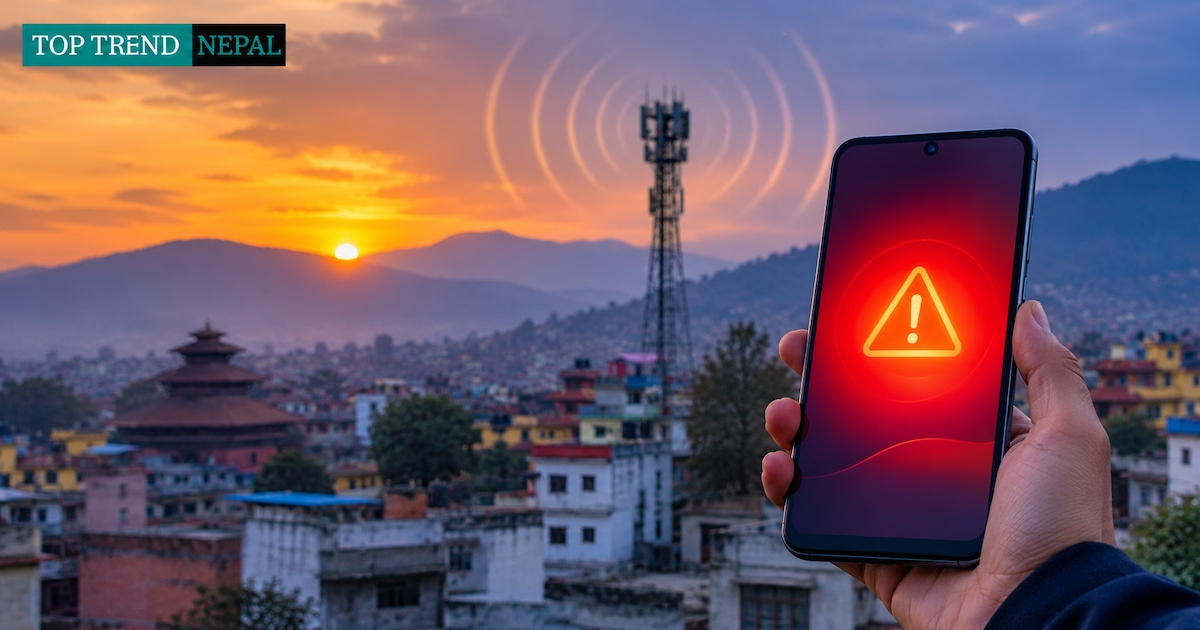
Nepal has completed the first technical test of its Cell Broadcast System (CBS), a new mobile emergency alert system built to warn people quickly during disasters. The test took place on Monday, November 23, 2026 (Mangsir 7, 2083), in parts of the Kathmandu Valley.
Some mobile users saw a "TEST ALERT" pop-up on their screens, with a warning sound and vibration. The government had asked people not to panic and to take no action.
This is the main disaster alert system in Nepal news right now, and it comes three months after a flood that exposed serious gaps in the old SMS-based warnings.
What Happened During the Cell Broadcast System Test
The test was conducted by the Ministry of Communication and Information Technology and the Ministry of Home Affairs. The Nepal Telecommunications Authority (NTA) and Nepal Telecom (NTC) supported it. Reports also name the National Disaster Risk Reduction and Management Authority (NDRRMA) as a partner.
Key facts from the test:
- Date: Monday, November 23, 2026 (Mangsir 7, 2083)
- Time: Around 5:30 PM, according to the public notice
- Place: Selected areas of the Kathmandu Valley
- Source of the signal: Nepal Telecom's earth station and tower in Balambu
- Message: A "This is a test message" alert in Nepali and English, with a special warning sound
- Officials present: Information and Communications Minister Dr. Bikram Timilsina and Home Minister Sudan Gurung (spelled "Sudhan" in some reports)
NTA chairperson Arjun Ghimire said only a limited number of users might receive the alert. NTA spokesperson Min Prasad Aryal said the goal was to check the technical efficiency of the system and confirm that emergency messages actually reach phones.
Reports say the test was successful. Officials have not yet released detailed figures, such as how many phones received the alert or how fast it arrived.
What Is a Cell Broadcast System?
A Cell Broadcast System is a mobile network technology that sends one emergency message to all compatible phones inside a defined geographic area at the same time.
It is different from SMS. An SMS goes to a list of individual phone numbers, one by one. Cell broadcast sends the alert through mobile towers (cells) to every phone connected in that zone.
According to the International Telecommunication Union (ITU), the technology can send alerts that appear on the screen and trigger sound and vibration. This makes it useful for warnings about earthquakes, floods, landslides and severe weather.
Main features of Nepal's CBS
- No internet needed. The alert travels over the mobile network, not through data or apps.
- No phone numbers or personal data. The system targets an area, not individuals.
- Location-based. Only people in the chosen zone get the alert.
- Screen pop-up with sound and vibration. Hard to miss, even if the phone is in a pocket.
- Bilingual. The test message was sent in Nepali and English.
- Built in Nepal. Officials describe it as a locally developed technology.
Why Nepal Needed a Better Emergency Alert System
The test did not come out of nowhere. It follows the Bhote Koshi flood on August 26, 2026, one of the deadliest disasters in recent Nepali history. The flood hit Rasuwa and swept down through Nuwakot, Dhading, Gorkha and Chitwan. Reports on the death toll vary and have risen over time, but later accounts put it above 1,000.
The flood also showed how weak the SMS warning chain can be:
- Timing. Reports say a glacier or ice collapse happened around 8:37 AM. The Flood Forecasting Division says its first warning went out at about 9:15 AM, roughly 38 minutes later.
- Scale. The division says it sent 679,295 SMS alerts through Nepal Telecom and Ncell.
- Delays on phones. According to Kantipur, some people received the message much later than the sent time. Reports mention some phones getting it around 9:42 AM and others as late as 10:10 AM.
- Content. Reports and analysts said the messages were in Nepali only and gave little clear guidance on what to do next.
- Damaged network. Reports say dozens of Nepal Telecom and Ncell towers and fiber lines were swept away by the flood, cutting off areas downstream.
- Very short lead time. NDRRMA chief Dharmaraj Upreti said the time near the border was only four to ten minutes, and sending the alert itself took about five minutes.
Because of this, people started asking whether SMS alone is enough. The government is now testing cell broadcast as an alternative.
A GSMA/ITU study on cell broadcast for Nepal was carried out a few months before the flood. It estimated a cost of about $1.75 to $3 million and said a zone can be reached in about 10 seconds, according to a report by OnlineKhabar.
SMS Alerts vs Cell Broadcast: Key Differences
Feature | SMS alert | Cell Broadcast |
|---|---|---|
How it is sent | To individual phone numbers | To all phones in a set area |
Needs a subscriber list | Yes | No |
Can be delayed by network load | Yes, messages queue up | Designed to avoid message queues |
Screen pop-up, sound, vibration | Usually not | Yes |
Needs internet | No | No |
Collects personal data | Uses phone numbers | No personal data needed |
What Happens Next
Authorities say they plan to expand the system in phases. The first priority is areas at high risk of disasters, such as flood-prone and landslide-prone regions, if the initial trial is judged successful.
Several questions are still open, and officials have not answered them publicly yet:
- When will the system go live outside the Kathmandu Valley?
- Will it work on all phones, including older models and basic handsets?
- Will it work across all networks, including Ncell?
- Who will have the authority to trigger a real alert, and how fast can they do it?
- Will real alerts include clear instructions, such as where to go and what to do?
Experts have also made a wider point. Writing in The Kathmandu Post, one columnist argued that SMS and cell broadcast should be combined with sirens, radio, TV, loudspeakers and community networks, because no single channel reaches everyone. A fast alert helps only if people know what action to take.
What Should You Do if You Get a Test Alert?
If you receive a "TEST ALERT" or "परीक्षण सन्देश" message:
- Do not panic.
- Do not take any action. Officials have said none is needed.
- Do not mistake it for a real warning.
- Share the correct information with family members, especially older relatives who may be confused.
Final Word
Nepal's Cell Broadcast System test is a clear step toward a faster, more reliable early warning system. It will not prevent disasters. But if it can deliver clear alerts to the right people within seconds, it can give families the time they need to move to safety.
The real measure will come after the test phase: how wide the rollout is, how many phones it reaches, and how well it works on the day a real disaster strikes.
Frequently Asked Questions (FAQs)
What is the Cell Broadcast System in Nepal?
It is a locally developed mobile alert technology that sends emergency messages to all compatible phones in a chosen area at once. The alert appears as a pop-up with sound and vibration.
When was the Cell Broadcast System tested in Nepal?
The first technical test was held on Monday, November 23, 2026 (Mangsir 7, 2083), in selected areas of the Kathmandu Valley.
Who conducted the disaster alert system test?
The Ministry of Communication and Information Technology and the Ministry of Home Affairs led it, with the Nepal Telecommunications Authority and Nepal Telecom. NDRRMA is also named in several reports.
Where was the alert sent from?
The test alert was sent from Nepal Telecom's earth station and tower in Balambu, Kathmandu.
Did I need to do anything when I got the test alert?
No. The government said it was only a test and asked people not to panic or take any action.
How is cell broadcast different from SMS?
SMS goes to individual phone numbers and can be delayed when networks are busy. Cell broadcast goes to every phone in an area at once, with a screen pop-up, sound and vibration.
Does the system need internet or my phone number?
No. It works over the mobile network without internet data. It targets a location, so it does not need personal numbers or private details.
Why is Nepal introducing cell broadcast alerts?
Questions arose about SMS alerts after the August 26, 2026 Bhote Koshi flood, when some people got warnings late or not at all. Cell broadcast is being tested as a faster alternative.
Will the system cover the whole country?
Authorities plan to expand it in phases, starting with high-risk areas such as flood-prone regions. No full national timeline has been announced yet.
Which disasters can the system warn about?
It is designed for early warnings about floods, landslides, earthquakes and other emergencies.
Will my phone receive these alerts?
Support depends on your phone model, software and network. Officials have not yet published a list of compatible devices. If you did not get the test alert, it may be because you were outside the test zone, as only a limited number of users were included.
Will real alerts replace SMS and other warnings?
Officials have not said SMS will be removed. Experts recommend using several channels together, such as cell broadcast, SMS, sirens, radio, TV and community networks.
Tags
Comments
0No approved comments yet.

Sudip Acharya
SEO SpecialistSudip Acharya is an SEO Specialist, Web Developer, and Content Strategist with expertise in technical SEO, on-page optimization, schema markup, and modern web technologies. He specializes in building high-performance websites using WordPress, Next.js, and Payload CMS while developing content strategies that improve search visibility and user experience. His work focuses on creating scalable digital solutions, optimizing website performance, and helping businesses grow through data-driven SEO and content marketing.
View all articles